
I love driving tractors. You may have noticed me mention that before if you have read my other postings on tractors, but I felt it was worth mentioning. I love driving any large equipment really.
When I was in the Coast Guard, I had the opportunity to drive lots of large machines during my time on the USCGC George Cobb. That is a buoy tender based out of Los Angeles, California. The Cobb’s primary mission was to maintain a fleet of 300 sea buoys up and down the California coast. That was no small task for a crew of around 25 people.
My role there began as a deck rigger, during which I learned the basics of controlling and securing large cylindrical steel buoys at sea. For that role, I used lots of chains and hydraulic wenches of various sizes, and learned to drive a 45-ton Fork lift. Then, I eventually moved up to operating the primary crane on the ship.
Running a large piece of machinery is both nerve wracking and exhilarating. First off, large machinery seems to often have very minimal controls with little to no resistance. That crane, for example, had two joysticks that tons of steel with the a barely perceptible movement of the hand. Trying to move a large articulating mechanism with precision by minimally moving a joystick fractions of a millimeter is frustrating to learn, but personally fulfilling when mastered.
Bringing this back to tractor driving, I find a lot of the same difficulties and pressures behind the wheel of them too. In the photo with this blog, I am driving the New Holland with the transplanter implement on the back. The way this planting regiment is laid out, pulled plastic raised beds that are approximately 36-inches wide, and now we are planting into them. There are the challenges of driving tractors (throttle, gearing, attaching implements), and then there is the challenge of driving it straight without GPS.
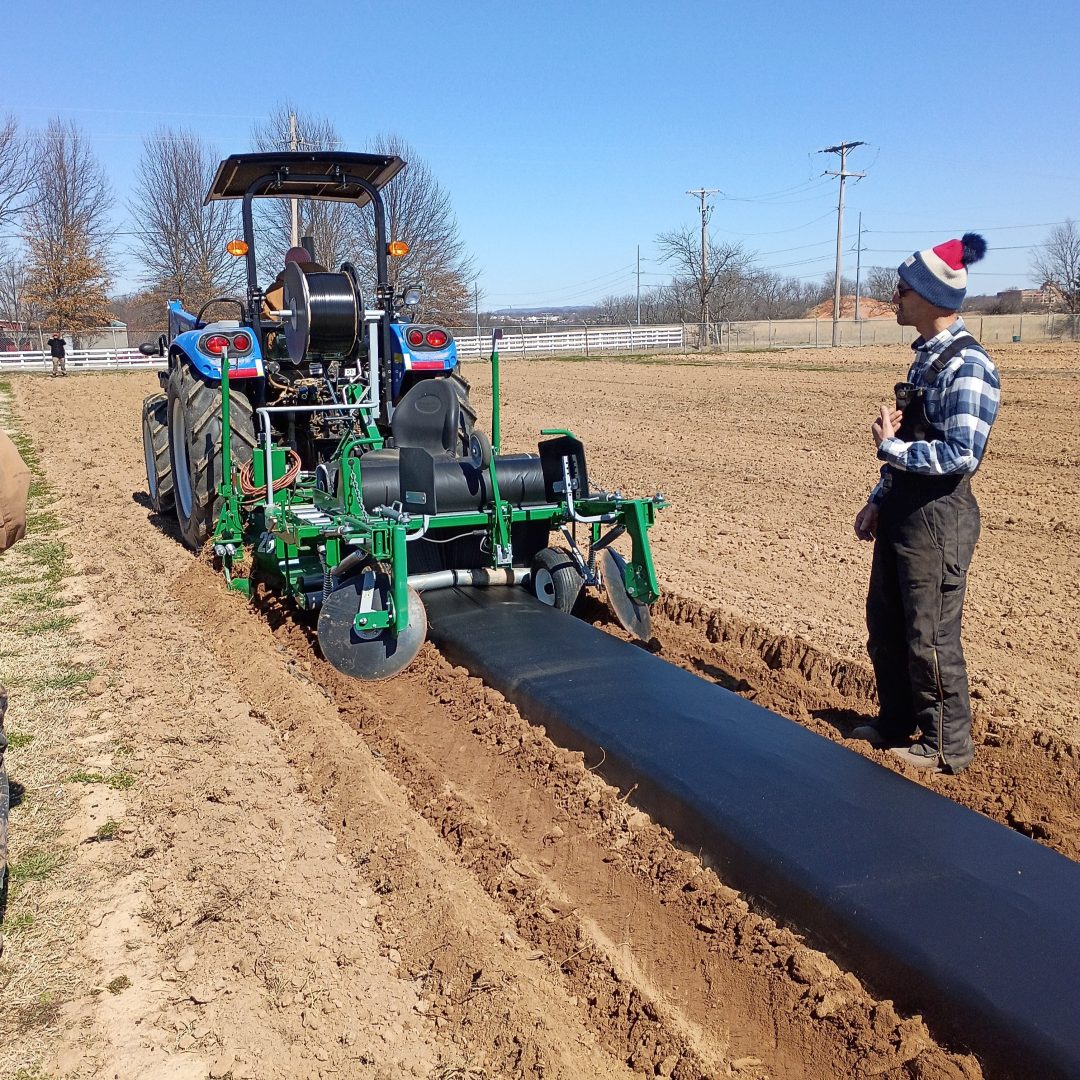
Everything we are doing in farm school, we are doing without GPS. That means everything we do must be done by sight and feel. That is easier to accomplish in theory than it is in practical application. Laying a straight raised bed of plastic may seem easy since the implement is really doing all the work, but the unexpected thing is that a slight wiggle of the steering wheel due to some shifting dirt or a shift in the seat can cause a permanent wiggle in the plastic. Then that wiggle is going to be there all season as you drive the transplanter and cultivator over it trying to straddle the plastic without hitting it with you wheels or running your transplanting wheel off the side (both of which I have done in the course of learning).
In the end, the stress is half the fun. When tasks are easy, they get boring quick. When a task requires concentration and constant vigilance, for me, it requires a level of focus that takes me into a flow state. The concentration and the meticulous dedication to the task become the rush.
Leave a Reply