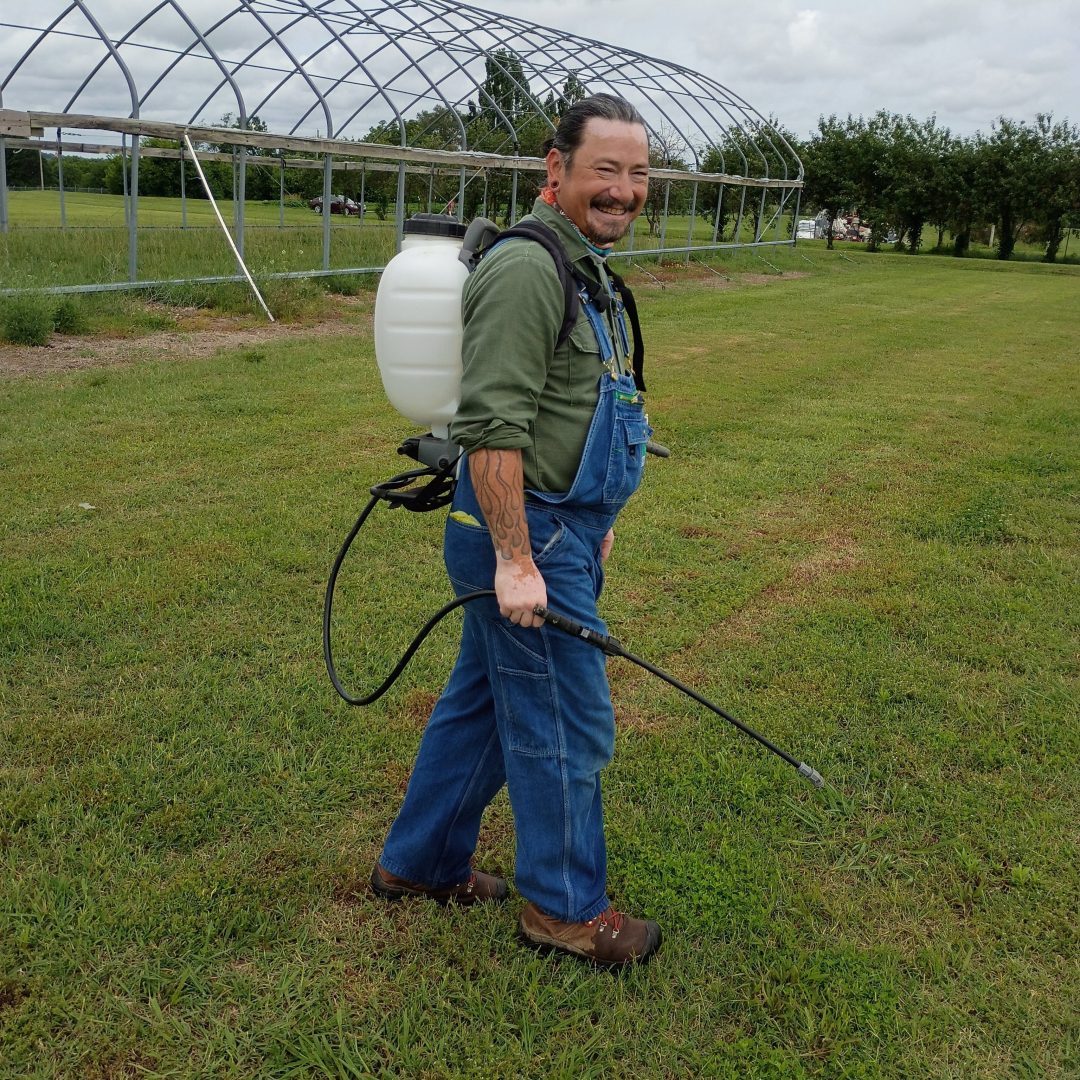
I’m sure even seeing a sprayer is triggering to some people because the general opinion is that organic farming means that no chemicals are used in the production of crops, but that is not entirely true. There is a lot of misinformation and false expectation out there regarding farming, and it does seem to swell around topics like defining organic, tilling the land, and regenerative versus sustainable versus productive. There’s a lot of opinion, and I am not here to settle it nor to really be a definitive voice for any side.
I am a new farmer, so at this point I have to stand on the shoulders and experience of several more experienced farmers’ best practices. While we are following organic practices, the school farmland is not certified organic. Instead, I am learning options that would most likely conform to the requirements of an organic inspector but there’s a lot more to it to actually get to that level. I’m at the baby-steps level.
All that being said, I had to turn to the sprayer because we have a pest problem in our field. We have healthy looking Rio Grande tomatillo plants, but they are being chewed up by grasshoppers and flea beetles. We originally anticipated fighting this pest pressure by planting two rows of Thai basil companion plants along the outer rows of our tomatillo bed. Since basil is fast growing, we expected that the basil would grow slightly behind the rate of the tomatillos transplants but still in similar proportion. That did not work.
After several weeks, the basil is barely breaking through but it is hard to distinguish it from the weeds that are also breaking through. So to keep the pests from completely decimating the young tomatillos, we needed a pesticide. Fortunately, there is Rango.
According to the advertisements, Rango is an all-in-one treatment that works as a pesticide, fungicide, and miticide. It’s composition is labelled as 70% Neem oil and 30% inert ingredients, but it is also labelled as OMRI certified, so this is an example of a chemical treatment that would probably be accepted by any organic certifier.
One thing I believed before, and am having constantly reaffirmed, is that farming is at least equal parts art and science with the probability of more art-ness than expected. What I mean is that there are procedures and best practices, but a farmer has to constantly make decisions along the process in response to a whole spectrum of changing factors and unexpected pressures. Farming asks for a ton of adaptation and flexibility, but can also introduce unexpected changes at unexpected times. It’s constant high stakes because each of these decisions will affect the life of the plants and the yield of the crop.
So I agree that it is good to question practices and methods, and even to debate if there is a better way, because that is how progress is driven. But there is also a point where I think it should be assumed that every farmer is doing the best they can with what they have and what they know. And sometimes, what may appear as a undesirable solution according to public opinion, may be a decision that a farmer arrived at after trying other things that didn’t work this time.
Leave a Reply