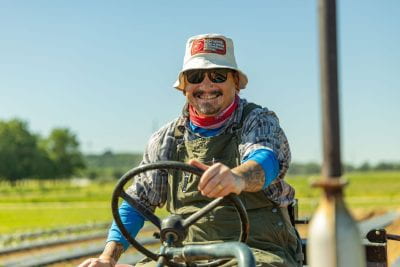
Below is a copy of the article that the Center for Arkansas Farms and Food published about me. I appreciate the positive write up. I am not sure who will read this or where it will go, but I’m glad to have my story officially shared by the school. It means I’m nearly done with the Farm School program and can begin living my farming vision.
Lou’s path to farming isn’t the one you might expect. Before joining the CAFF Farm School, he spent years serving others through humanitarian work, nonprofits, the military, and healthcare. Today, that same passion for public service is leading him somewhere new: the farm.
Originally from San Antonio, Lou has lived all over the world, including Kuwait, Japan, California, and Kansas. Last August, he and his wife chose Northwest Arkansas as their new home, drawn by its natural beauty, affordability, and proximity to family.
His resume reflects a lifelong commitment to helping others. Lou has served with AmeriCorps, the U.S. Coast Guard, the California Conservation Corps, and several nonprofit organizations. He earned a master’s degree in business administration along with degrees in journalism and photojournalism, worked in public affairs during his military service, and later supported a nonprofit hospital through its communications department. He recently completed a media and outreach internship for Spring Creek Food Hub and currently works with For the Love NWA on their weekly “Neighbor Nights,” serving free meals to hundreds of people each week.
Throughout every chapter, one thing has remained constant.
“I’ve always used my love of public service to navigate through the nonprofit sector,” he said.
Ironically, farming wasn’t part of the original plan.
In fact, Lou had no traditional farming experience before coming to CAFF. His closest connection to agriculture was an unusual apartment hobby: raising composting worms.
“I only had a ‘red wiggler’ ranch,” he laughed.
After downsizing to an apartment, he and his wife decided against pets. Instead, Lou built a stackable worm composting system, experimented with aquaponics, and even started a blog, Makingfood.blog, to document his journey.
Still, he never imagined becoming a farmer.
That changed after taking one of CAFF’s short courses.
“It lit a spark,” Lou said.
One conversation with an experienced farmer transformed curiosity into calling.
“There was this feeling of acceptance that you just don’t get in this world anymore—an instant welcome to the tribe,” he recalled. “It was like, ‘If you’re willing to accept this challenge, we’re ready to accept you.’”
That simple exchange changed everything.
“I was all in after that.”
Today, the man who had never considered himself a gardener has plants filling his home—a change his wife fully supports.
For Lou, farming isn’t simply about growing vegetables. It’s about addressing one of the biggest challenges he has witnessed throughout his career.
Working as both a first responder and in a hospital, he has seen firsthand how poor nutrition contributes to chronic health problems.
“So much of my work has been downstream,” he explained. “Farming lets me go upstream.”
Instead of helping people after health issues develop, he wants to prevent those problems by increasing access to fresh, nutritious food.
That mission shapes the kind of farmer he hopes to become.
Rather than focusing on gourmet varieties, Lou dreams of growing affordable, nourishing vegetables for communities that need them most.
“I’m not as interested in growing fancy heirloom tomatoes,” he said. “I’d rather grow collards in mass that people can throw in a pot and feed themselves.”
His long-term vision is equally creative. After completing Farm School, he hopes to build a network of small urban growing spaces and eventually create a mobile produce stand—a vegetable bus that brings fresh food directly into neighborhoods with limited access.
The idea came from an experience years ago when his son was in preschool. A colorful bus converted into a portable greenhouse visited the school, introducing children and families to affordable, fresh produce.
“It was inspiring,” Lou said. “People were leaving with bags of healthy food.”
He hopes to create something similar in Northwest Arkansas.
While he acknowledges that farmers markets and farm-to-table programs play an important role, he believes there is still work to be done.
“So many great ideas miss the people who need them most,” he said. “Farmers markets aren’t usually located in food deserts.”
His goal is to help change that.
Life on the farm has already proven to be every bit as challenging as he expected.
“Farming is high-stakes,” Lou said. “It can be unfair and even cruel.”
Storms can flatten crops. Hail can wipe out weeks of work. High tunnels can be damaged overnight. Yet those setbacks are balanced by moments of pure joy.
“There really is no other feeling like planting seeds and then coming back to see them coming up,” he said. “It fills you with hope and potential. You think, ‘I did that.’”
That’s what keeps him coming back.
He appreciates that CAFF Farm School teaches through real experience rather than perfect conditions.“Nothing is sterile or planned out,” he said. “You work with the weather, you solve problems, and then you get to celebrate when things recover.”
For anyone considering farming—or wondering whether CAFF is the right place to begin—Lou offers simple advice.“Start with one of the short courses,” he said. “Honestly, the Farm School sells itself. Being on the farm and around the people is infectious and inspirational.”
For Lou, farming has become much more than learning to grow food. It’s a continuation of a lifetime spent serving others—only now, that service begins with healthy soil, growing plants, and a vision of making fresh food accessible to everyone.
It’s a mission rooted in hope, and one that’s just beginning to grow.
Leave a Reply